
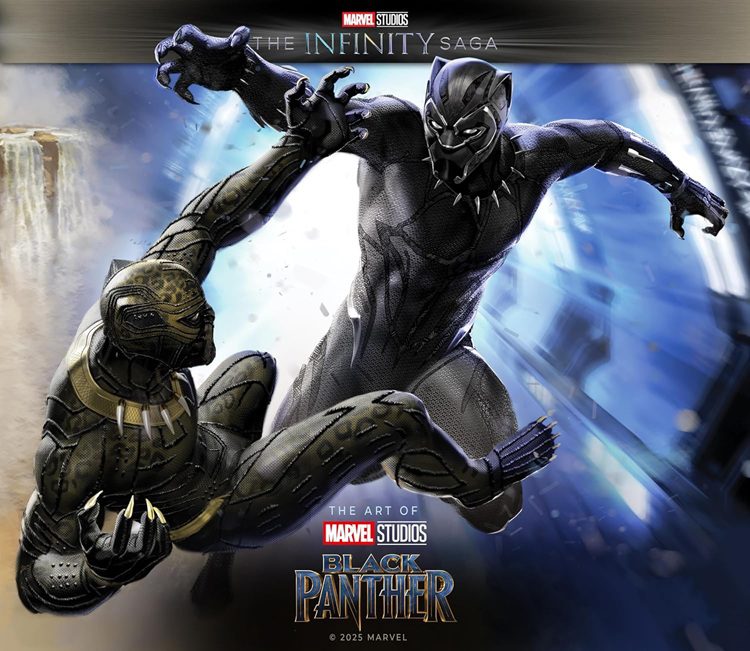
Marvel Studios: The Infinity Saga – The Art of Black Panther is the 17th release in the 22-book Marvel Studios: The Infinity Saga series, which is republishing previously released art books as a resized matching set. Under the guidance of director/co-writer Ryan Coogler, Black Panther allowed the artists an opportunity to create yet another new world within the Marvel Cinematic Universe: the nation and culture of Wakanda. In his review of the movie, Matthew St. Clair wrote, “it is brilliantly brought to life in the production design by Hannah Beachler and the costume design by Ruth E. Carter who give each set piece and wardrobe such vivid and colorful detail.” In his Foreword, Coogler credits them along with Visual Development Supervisor Ryan Meinerding, VFX Supervisor Geoffrey Bauman, and others “who were involved in” making Black Panther.
Buy The Art of Black PantherSpeaking of the Foreword, it’s immediately apparent the font size is smaller than previous volumes in this series. Flipping through the pages, this small size is unfortunately uniform throughout the book, making it difficult to read. Another poor formatting decision is some of the text passages are white letters on a colored backgrounds. While images are the main attraction for an art book, the accompanying text in past volumes offer great insight to those interested in the pre-production process as crew members rarely heard from reveal what went into the creative decisions and directions. Here, it takes such an effort the reader’s patience will be tried, especially white on light gray.
The book starts with art dedicated to the topography and architecture of “Wakanda.” Executive producer Nate Moore explains their desire “to make Wakanda feel like a place that could exist on Earth rather than some completely made-up place.” The various Wakanda tribes each have their own identity, which comes through their costumes, and main figures within the tribes get a page to spotlight them. The chapter than moves into Shuri’s lab and presents Wakandan technology.
“Black Panther Legacy: Dawn of Legend” starts with numerous classical designs for T’Chaka, who was Black Panther/leader of Wakanda before T’Challa. Concept Artist Andy Park “was exploring looks that felt very classic Black Panther, but also trying to make it distinct from the modern-day look.” After a brief sojourn to the Hall of Kings “where Wakanda’s dead leaders are buried” and the Ancestral Plane where T’Challa goes to “seek wisdom from past rulers,” the book focuses on T’Challa, from his traditional garb as Wakandan King to the different aspects of his technologically driven Panther suit.
“Warrior Women of Wakanda” explores costumes and props of the Dora Milaje, Wakanda’s premier military force; Ramonda, the Queen Mother; and Shuri, T’Challa’s younger sister and quite the inventor. “Threats to Wakanda” brings on the bad guys: Erik Killmonger and Ulysses Klaue. The former went through many costume iterations before the right design was found. For the latter, the book focuses on his arm/weapon. “Battle for the Throne” sees T’Challa take on challengers for the crown, and with his loss, the design for the new Panther had to be created.
The Art of Black Panther captures Afrofuturism entering the MCU as the hero and his homeland increased their presence after their initial appearance in Captain America: Civil War. Getting to see the details worked out by a talented group of artists is a fun experience. It’s a shame reading about it was made so difficult by the books formatting.
