
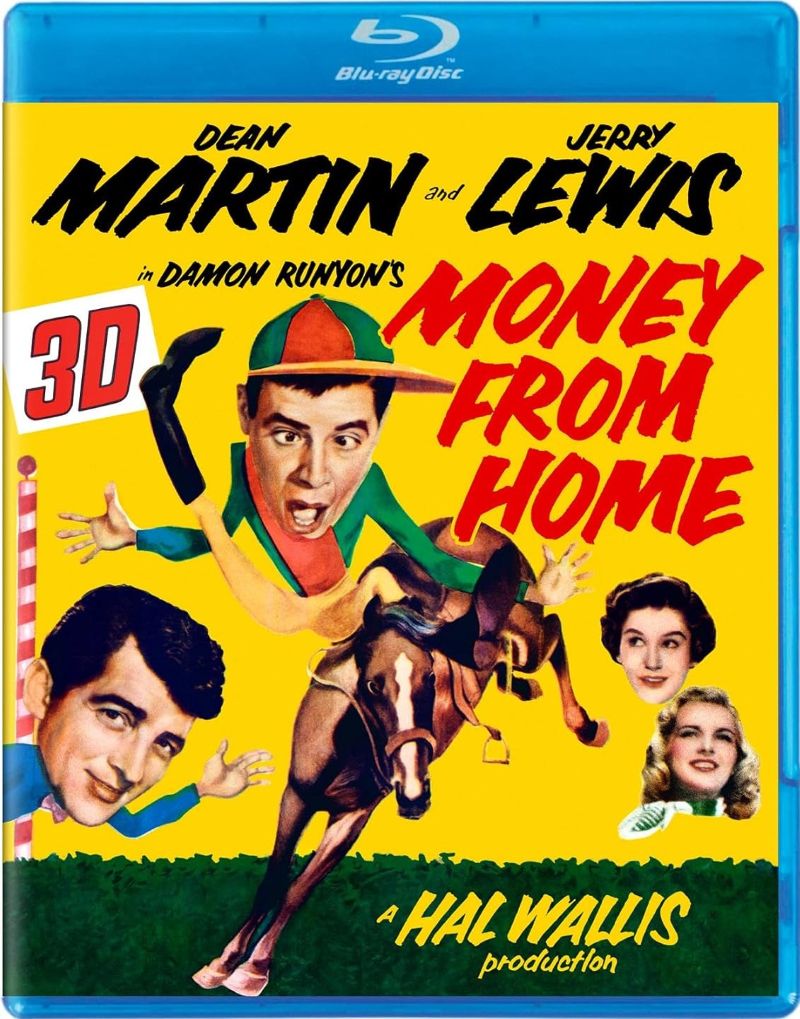
When 3D first became a movie theater fad in the 1950s, the technology occasionally drifted outside of its typical sci-fi applications. Still, this film must be one of the most unlikely 3D projects, enhancing a fairly typical Martin and Lewis comedy for little apparent improvement. If you’re a fan of their comedy films, Money From Home is a seamless continuation of their brand. However, 3D enthusiasts looking for technical magic should expect to be left underwhelmed.
Buy Money From HomeWhen Honey Talk Nelson’s (Martin) gambling debts threaten his well-being, he comes up with a harebrained idea to use his doltish animal-whisperer cousin Virgil (Lewis) to fix a horse race. Meanwhile, Nelson pursues a romance with Phyllis (Marjie Millar), a bland beauty with the perky demeanor of a young Doris Day but the style of Lauren Bacall. Virgil also stumbles into a romance along the way, but really only has eyes for the horses and any other animals he encounters. Martin is all smooth cool, Lewis is in maximum nerd mode with high-pitched voice and awkward social interactions, they both get to perform songs, and the story progresses along to its pleasantly obvious conclusion.
The film is presented in 3D on the Blu-ray, but viewers have some choices to make. The initial menu option only displays the two 3D options: old-school anaglyphic requiring red/blue glasses, and the Blu-ray native stereoscopic format requiring compatible BD3D players, TVs, and glasses, which unfortunately fell out of manufacturer favor a decade ago. That latter format will be the preference for lucky viewers still in possession of functional equipment, but most viewers, including me, will be stuck with anaglyphic. Unfortunately, the package doesn’t include any red/blue glasses, so plan ahead to make sure you have a pair around if you want to explore the 3D experience.
This is not a 3D approach like modern attempts that send effects leaping past the proscenium into the audience. Instead, the overall effect is simply added depth in the backgrounds, with the stars generally in full standard focus in the foreground. There are no attempts to extend past the screen, with only one brief scene near the end where Martin and Lewis get close to the edge, aka slightly in front of the standard foreground focus. While it’s an interesting experiment and the depth of field is clearly expanded, the lack of screen-escaping magic ultimately makes the 3D a solution in search of a nonexistent problem.
For viewers interested in watching the film based on its traditional merits only, not its kitschy 3D, the only way to find the included 2D option is to first select the BD3D option from the main menu. It’s a peculiar method to locate the option that will likely frustrate casual viewers who don’t explore the top menu. However, it’s worth seeking out, as the remastered 2D colors are exceptionally vibrant and really make the movie shine, especially in comparison to the dull, faded anaglyphic hues that render the film closer to black and white than color.
The disc includes a fascinating new bonus feature about the film’s years-long process back to 3D, including its discovery in a warehouse and multi-stage restoration at both Paramount and 3-D Film Archive. It also includes a decidedly non-PC birthday song Martin recorded for Lewis, a slideshow of photos from the set, footage of Martin and Lewis recorded on set promoting a series of live shows in Detroit, as well as a teaser and theatrical trailer. Two different commentary tracks by film historians are also included.
