
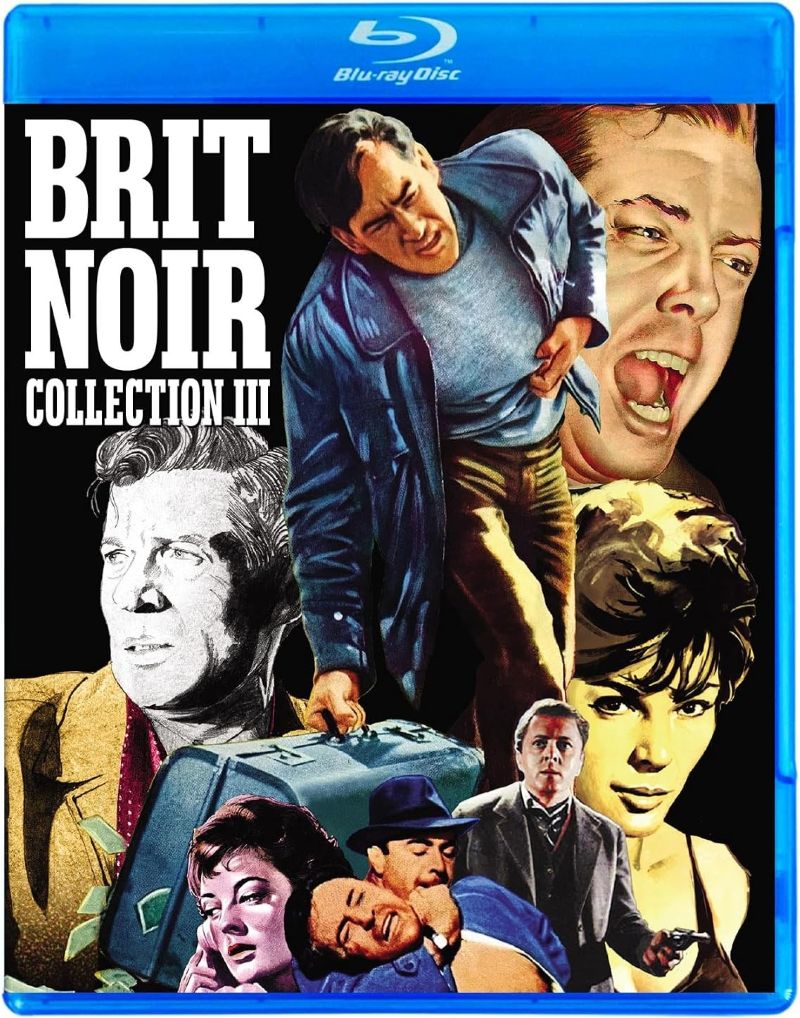
Kino’s third collection of late-period British noir compiles three tense dramas likely to be unknown to most viewers. While there’s no unifying thread between the three other than their shared Brit-noir genre, and little in the way of recognizable stars, they’re all worth watching.
Buy Brit Noir Collection IIINowhere to Go (1958) bears the distinction of being Maggie Smith’s film debut, with her character playing a young socialite who offers safe haven to an escaped convict. He’s no grizzled degenerate, with star George Nader instead playing the character like a debonair gentleman. His main goal is to recover the loot he stashed before he was busted, leading to a complex process of converting rare coins into cash while outwitting the cops and shady characters on his trail. Nader is fantastic as his character’s stress level visibly rises throughout the story, with disaster seemingly approaching at every turn. The cinematography is also superb, offering the most artistic application of noir influences, but the soundtrack is thin and scratchy.
The Man Upstairs (1958) dumps us right into the midst of a dingy London boardinghouse where the top-floor tenant seems to be slowly losing his mind, offering no context for the setup. Richard Attenborough stars as the pitiful and solitary tenant named Peter who eventually discloses his belief that he was responsible for the death of a man. Bernard Lee (James Bond’s original ‘M’) co-stars as the trigger-happy chief investigator dispatched with his team of cops to quell the disturbance. Meanwhile, the other neighbors congregate and tear into each other as they speculate about Peter’s potential issues, with some also attempting to de-escalate Peter’s situation before the cops take the nuclear option. The plot’s interesting approach never really explores the veracity of Peter’s beliefs, leaving them immaterial to the overall structure more focused on the escalating tension in the entire boardinghouse triggered by his late-night meltdown. Cinematography is bland and flat, but sound is robust.
Payroll (1961) is a classic heist film, until it isn’t. The story follows a streetwise ringleader who assembles a crew to carefully plan out and execute a daring theft of company wages from an armored truck, tracking along typical heist expectations until the operation is concluded before the film’s midpoint. That’s where things really get interesting, as the crooks attempt to lay low for weeks until the coast is clear, while simultaneously suspecting each other of potential foul play. When the dogged widow of a murdered payroll guard also gets involved, she acts as the principal destabilizing agent threatening to blow up the entire plan. While the photography is also fairly uninteresting here, the twisty plot makes for a thrilling ride.
All three films are in black and white and offer commentary tracks by assorted film historians. No other bonus features are included. Picture quality is excellent, with clean images and rich, consistent contrast levels, while DTS mono sound is adequate if unspectacular due to the original film production quality.
