
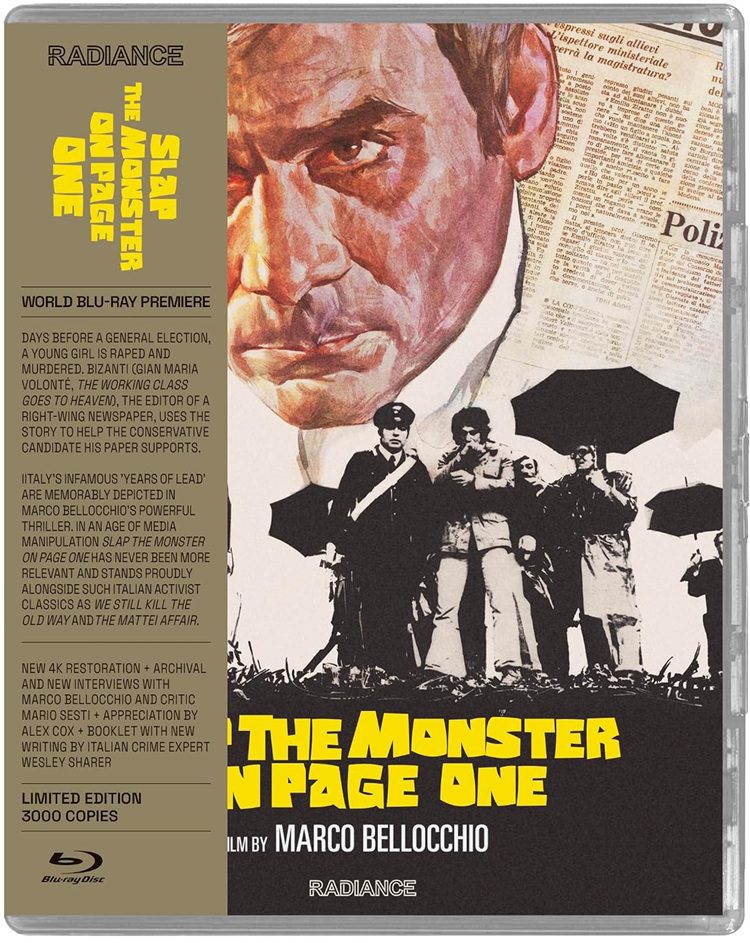
Near the end of this Italian political drama, Bizanti (Gian Maria Volonté), the chief editor of a right-wing, pro-fascist newspaper, berates his wife. She is so stupid, he declares. He’d rather converse with the wallpaper than talk with her. How is it possible she doesn’t understand that the things he writes in the paper, and the things he often says in public, aren’t really the things he actually believes?
Buy Slap the Monster on Page OneI have to admit that I often felt like that poor woman while watching this film. I felt stupid and confused, never quite sure what was going on. Part of this was my fault. I went into this film expecting a violent, action-filled poliziotteschi, and what I got was a rather languid political drama. I also had a terrible sinus headache, which made it difficult to follow the ins and outs of this somewhat complicated story.
Films often reflect the culture and times in which they are made. The 1970s in Italy were marked by violence and political turmoil, and the films often reflect that. I’ve watched more than my fair share of Italian films made during the Years of Lead, and every one of them was political. But they were also filled with car chases and gun battles. This film is all politics.
It begins with a political rally in which a man shouts at the crowd that it doesn’t matter if you are fascist or anti-fascist because both can agree that they must stop the communists. We are then treated to a parade and rallies where we see banners for seemingly every political party in Italy at the time.
One of the rallies turns violent, and several people throw rocks at a newspaper building, smashing their windows. Then a Molotov cocktail is tossed, igniting a rack of newspapers on fire. Before the fire is put out, the newspaper men make sure a photographer is called in so he can document it. Their building might be burning, but it sure will make a good story.
A young woman is found raped and murdered; it becomes a news sensation. The police, seemingly working in tandem with the newspapers, let journalists follow them just about everywhere. Bizanti goes so far as to investigate matters himself, ultimately suggesting who the killer might be. His paper does more than suggest. It points fingers and flat-out calls a left-wing student the culprit.
Digging deeper, he’ll speak to the supposed killer’s much-older girlfriend, Rita (Laura Betti). She gives him an alibi, so Bizanti lies, cajoles, and threatens her until she changes her story. When he discovers the real killer’s identity, he doesn’t go to the police, and he keeps the information out of the paper because the actual motive is much more mundane than the story he’s created.
It is difficult not to compare this film to what is currently going on all around me. The press and social media are constantly lying to us and manipulating stories to increase their profits and change outcomes. I guess it is nice to know this has always been going on, but also deeply depressing.
As I’ve been writing all of this out, I feel like I’ve made the film more interesting and exciting than I actually found it to be. Maybe that headache really did keep me from enjoying what is really an exceptional film. Looking at reviews on Letterboxd indicates that I am almost certainly wrong, or at least in the minority. Or maybe the ideas in the movie are far greater than the actual filmmaking. Wesley Sharer makes a good case for this being a great film in his essay included in this Radiance Films release. I think I shall have to watch it again sometime. But not soon, and certainly not with a raging sinus headache.
Radiance gives the film a nice-looking 4K restoration from the original negatives. Extras include an archival interview with Marco Bellochio, the film’s director; a new interview with critic Mario Sesti; and a different one with filmmaker Alex Cox.
