
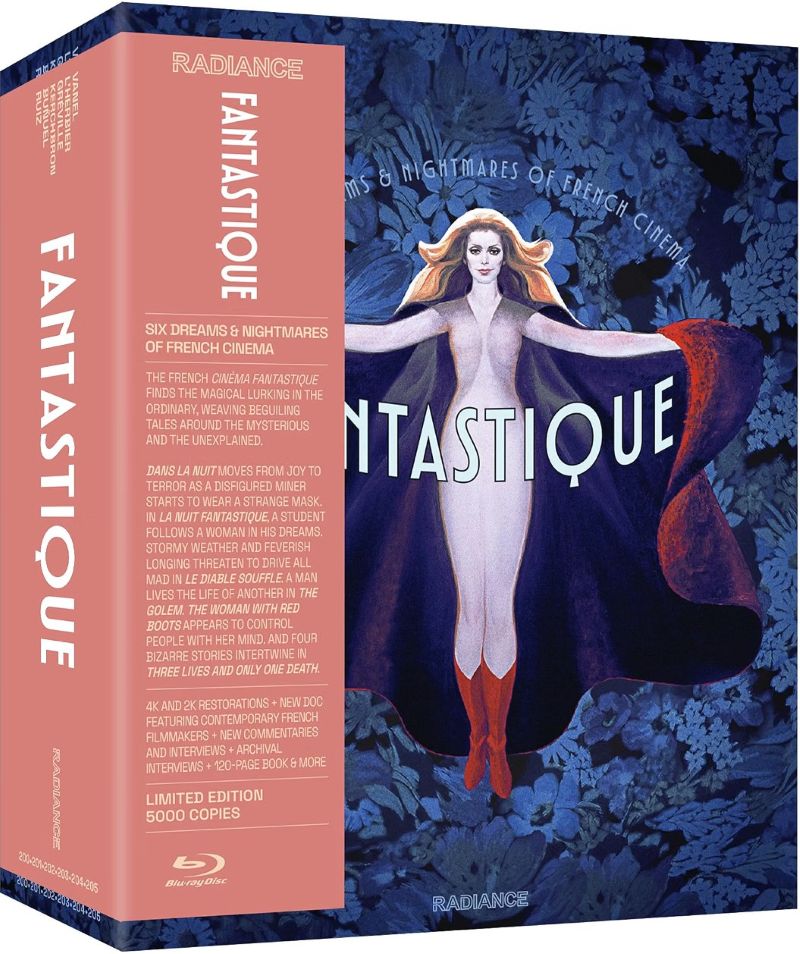
Radiance’s newest box set whisks viewers through a tour of French genre films that push the boundary between realism and fantasy. The films have no unifying themes, creators, or even eras, dating back as far as 1930 all the way through 1996, appearing together solely due to their loose affiliation with the fantastique. The vast timespan makes for a set that feels a bit uneven at times, with the final two star-studded color films seemingly holding far greater marquee value than the four black-and-white efforts. All of the films have their merits, but also would likely stand stronger as individual releases rather than as parts of this deeply fascinating but somewhat contrived set.
Buy Fantastique: The Dreams and Nightmares of French CinemaDans la Nuit (1930) bears the distinction of being France’s final silent film, which unfortunately doomed its original theatrical run. With audiences flocking to talkies, star Charles Vanel struggled to launch his directorial debut, which is a shame because the production is darkly eerie and quite memorable. He plays a newlywed mine worker who becomes disfigured in a workplace accident, forcing him to wear a partial mask like the Phantom of the Opera and straining his relationship with his wife. When she turns to one of his co-workers for solace, the husband ends up in a deadly showdown that determines all of their fates.
It’s a stretch to align this film with the fantastique genre, as there are no mysterious or surreal elements until the final scene. However, it is a strong story anchored by Vanel’s mournful performance, and it is well-deserving of its rescue from nearly a century of obscurity. The film has been restored in 4K from the original nitrate negative, and the results are impressive considering the age of the film, with only a few lingering imperfections. The disc includes a new introduction to the film, along with a new commentary by a film historian.
La Nuit Fantastique (1942) is stuffed with fun camera trickery, effects, and Lynchian madness, making it a standard-bearer for the fantastique genre. Plot is an afterthought, but vaguely focuses on an exhausted philosophy student who falls asleep at his night job, possibly entering a dream world to rescue a mysterious woman in white while ignoring his very real girlfriend. There’s an evil professor/magician who may or may not be the mystery woman’s father, and the student foolishly risks his life to save her believing nothing bad can happen if he’s in a dream.
There are similarities to Powell and Pressburger flights of fancy, and director Marcel L’Herbier shrewdly maintains ambiguity about whether the events portrayed are occurring in a dream or reality. The film represented an escape from reality for L’Herbier as well, made in France under German occupation and filled with homages to Méliès and Lumière. The film was restored in 4K from the original nitrate negative, but the transfer remains riddled with fine scratches. Bonus features are an archival interview with L’Herbier, as well as an interesting, extensive discussion about the film and its perilous creation in the occupation era.
Le Diable Souffle (1947) takes place almost entirely in a small house perched on a tiny island in the middle of a raging river in the Basque region between France and Spain. The owner is a grizzled old French bachelor who takes a rare excursion to a nearby town, where he meets and falls for a comely but ailing young nightclub piano player. When she gets fired for literally falling down on the job, he swoops in to be her elderly white knight, quickly marrying her and spiriting her away to his isolated island home. All is well until a handsome young Spanish drifter washes up on his shore, setting up a love triangle with disastrous results.
As with Dans la Nuit and its love triangle, there’s virtually nothing fantastique about the film save for one very brief scene.Thankfully, it also shares the strong story comparison, made all the more impactful by its unique setting on the flood-ravaged, wind-swept island. The 4K restoration was sourced from original image and sound elements, resulting in a clean transfer with minimal flaws. The sole bonus feature is a discussion of director Edmond T. Greville’s journeyman creative career.
Le Golem (1967) rehashes the 1915 novel into a super-surreal, exceptionally verbose production that is short on plot but long on moody style. Originally made as a TV-movie, the film still feels like a theatrical release due to its fine production design and spooky, dark cinematography.
Rather than spooling out the narrative in a linear fashion, director Jean Kerchbron sticks to fragmented visions that gradually reveal elements of the golem-monster story. As a result, it’s hard to parse out a plot, and the events are so fractured and over-scripted that it’s difficult to maintain interest. Still, the supernatural golem subject and surreal visions make for a film that earns its place in the set.
The 4K restoration team utilized the original 35mm image negative and 35mm mono magnetic sound track to craft an exceptionally clean transfer. Bonus features are an archival introduction by a co-writer of the film, along with a lengthy, dry visual essay about golem history.
Next up, we come to the cover girl for the box set, Catherine Deneuve starring in The Woman in Red Boots. The film is nepo fantastique, directed by esteemed weirdo Luis Buñuel’s son, Juan Luis Buñuel. Deneuve plays an artist in residence at a freaky house owned by a wealthy eccentric played by Fernando Rey. People within the house have surreal visions, and Buñuel teases out whether Deneuve’s character has any supernatural abilities enabling the visions. The titular red boots are not at all remarkable and go entirely unmentioned, a dull reddish brown shade upstaged by far more vivid splashes of red throughout the film.
Deneuve is devastatingly beautiful, fully enforcing her character’s ability to seemingly exert her will on other mere mortals. She also appears in an archival bonus feature interview where she briefly contrasts her time starring for both Buñuels, although this film pales in comparison to daddy Buñuel’s Deneuve classic, Belle de Jour. Still, it’s a smartly made film with enough surreal flourishes to keep things visually interesting, even if the story runs out of steam. The 4K restoration is superb, with only a stray hair marring the top edge of one shot, light grain, and rich, warm colors. Other bonus features are a 20-minute look at the film’s fashion and colors and a 15-minute dissertation establishing the film’s place in the pantheon of French fantastique cinema.
The final entry is also my favorite of the set, Marcello Mastroianni playing a man with four distinct personalities and stories in the surreal comedy-drama, Three Lives and Only One Death (1996). The sight of the veteran legend gleefully embracing the distinct character changes is made all the more poignant by the knowledge that it was his penultimate performance, filmed the year before his death. It’s further enhanced by the presence of his (and Deneuve’s) actual daughter Chiara, here early in her acting career playing opposite her father as his daughter in some particularly moving scenes.
The surreal elements are subdued, more related to the split personality changes than visual trickery. Director Raul Ruiz makes us question which of the character’s lives and loves are real, with each personality change including different lovers who may be figments of his fractured imagination. He also employs a particularly lively camera with intriguing angle choices, making for visually impressive storytelling to augment the perplexing tale. There’s also a fun shot in a bar with a wall-size mural of the star of Alphaville observing the action, one icon peeking in on another.
Oddly, the newest film was the only one not restored in 4K, instead settling for 2K. The transfer is flawless, although colors are a bit subdued. Bonus features are an archival interview with the Mastroiannis at Cannes promoting the film, along with an insightful hour-long overview of the fantastique genre.
The box set devotes a disc to each film, with two discs housed in each of the three full-height Scanavo cases, with removable obi strips and reversible cover art also included. The 5,000-copy limited edition also contains a weighty 120-page book featuring new and archival writing by film experts about the genre and select films.
Although the films vary in their embrace of the fantastique and share virtually nothing in common, they’re all well worth watching and make for a rewarding taste of seven decades of French cinema.
