
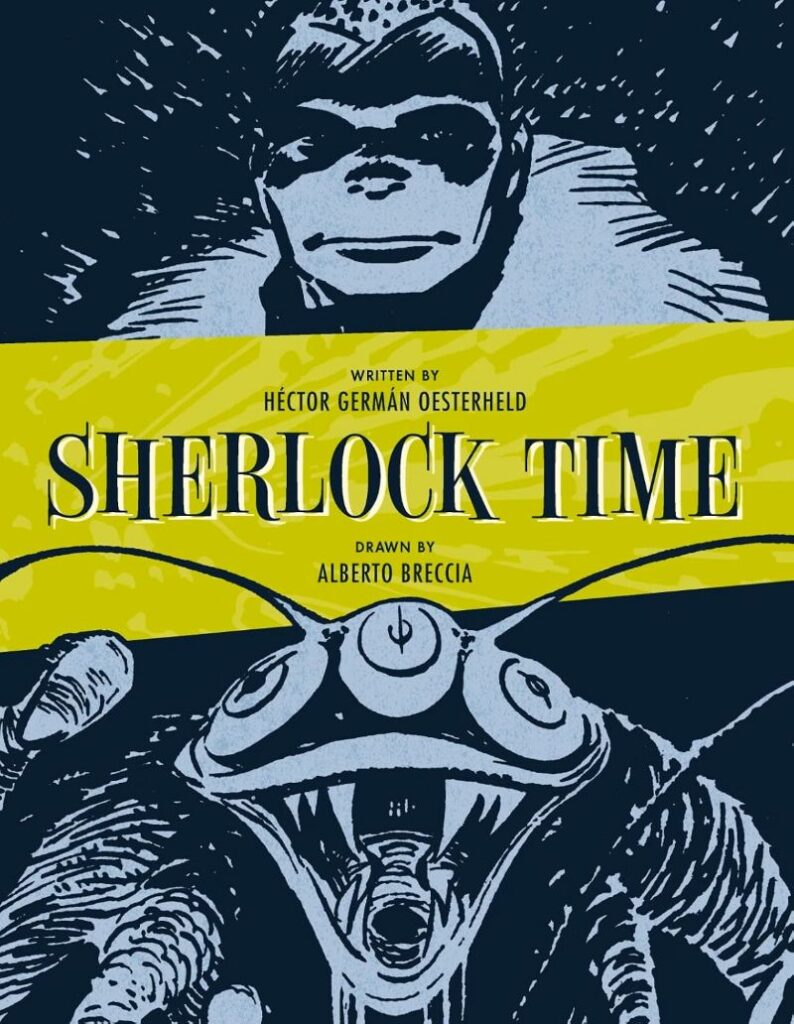
When a newly retired man buys an abandoned mansion for a pittance, he inherits all of its contents, including a mysterious visitor with an unusual obsession with the home’s attached tower. That tower turns out to be a spaceship hidden in plain sight, with launches and landings somehow completely unnoticed in the owner’s Argentinian neighborhood simply because a secondary underground tower automatically replaces it as needed.
Buy Sherlock TimeIn Héctor Germán Oesterheld’s fanciful serialized tales, Sherlock Time guides clueless sap Julio Luna through mysterious adventures throughout time and space. He borrows his name from Sherlock Holmes, with retiree Julio unknowingly acting as his ever-befuddled Watson, but the space/time components also bring to mind Doctor Who’s relationships with his companions. While Sherlock’s origins and motivations remain hazy, his brilliance and crisis management skills are uncanny, making him able to easily find a solution to whatever peril faces the pair. Among the threats are three-eyed aliens, a deadly tram car, space madness, and a supernatural idol.
Appearing just after EC Comics’ implosion in the U.S., Oesterheld’s Sherlock stories picked up the torch of weird tales for Argentinian readers, improving on the formula by focusing on the two recurring characters instead of EC’s one-off short stories. Like the EC output, the stories tend to be overwritten in the early going, but Oesterheld backs off a bit as the book progresses, allowing Breccia to tell more visually with his exquisite cartooning skills. Breccia responds by utilizing crisply rendered, expressive characters and moody shadows to set the spooky, surreal tone.
Aside from the standout 50-page tale “Three Eyes,” the episodic comics range from 8 to 20 pages, but they’re so densely packed with story and richly detailed panels that they seem much longer. It’s clear that the duo were chafing at the space constraints of the periodicals publishing the work, cramming in maximum value for their readers. There’s an unfortunate formatting shift at the 100-page mark that results in having to turn the book sideways to read subsequent stories horizontally, a remnant of the original periodical change that interrupts the flow but leaves the impact undiminished.
This collection represents Oesterheld and Breccia’s first pairing, predating their later collaborations on Mort Cinder, Life of Che, Evita, and Oesterheld’s aborted reboot of his earlier classic, The Eternaut. With all of those works previously published by Fantagraphics, the book represents a welcome addition to the collection that further cements their amazing legacy.
