
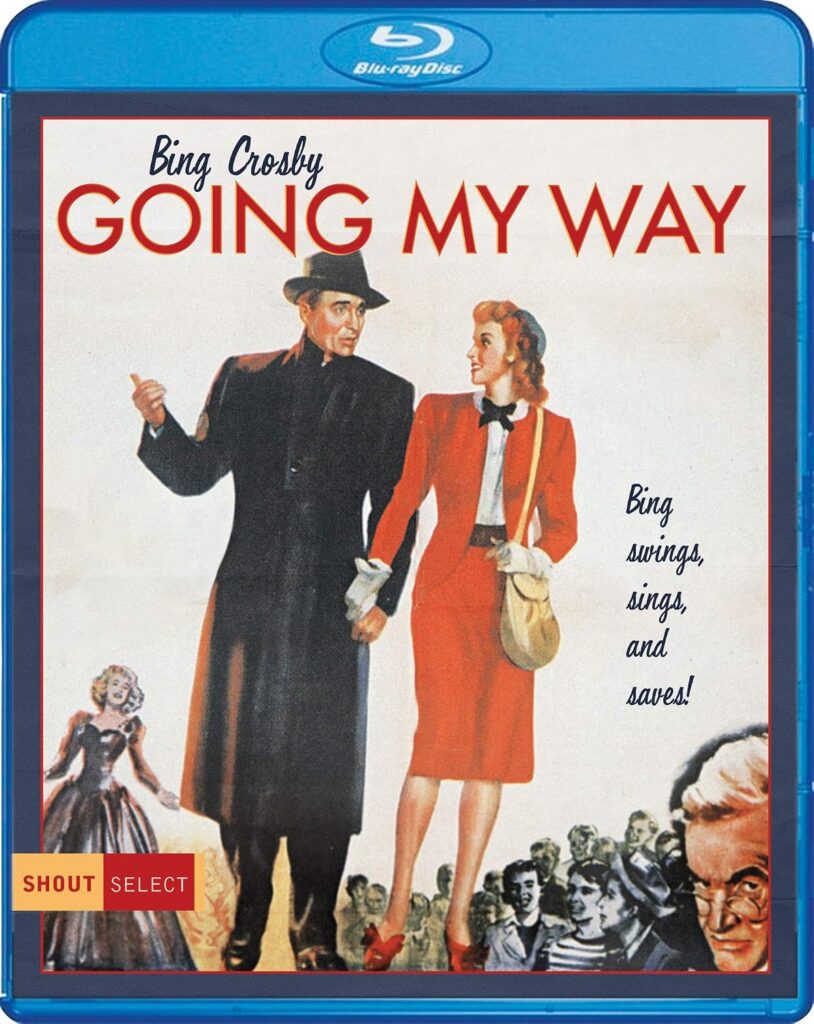
Leo McCarey’s Going My Way is a gentle musical comedy-drama that won seven Academy Awards, including Best Picture, but its considerable charm comes with a generous helping of sentimentality. Anchored by Bing Crosby’s relaxed performance and Barry Fitzgerald’s delightful turn as a stubborn old priest, the film offers an appealing portrait of faith, community, and the value of meeting people where they are. Yet its insistence on resolving nearly every problem with a song or a smile can leave the proceedings feeling a little too comfortable.
Buy Going My WayCrosby stars as Father Charles “Chuck” O’Malley, a young priest assigned to St. Dominic’s, a financially struggling New York parish overseen by Father Fitzgibbon (Fitzgerald). The older clergyman has spent decades doing things his way and views his new colleague’s unconventional methods with considerable suspicion. O’Malley prefers understanding people to lecturing them, and his easygoing approach soon wins over a group of neighborhood boys who might otherwise find themselves in trouble. He organizes them into a choir, giving the youngsters something constructive to do while providing the parish with a potential source of desperately needed income.
The central relationship between the two priests supplies the film with its strongest material. Fitzgerald makes Fitzgibbon cantankerous without rendering him unpleasant, revealing a lonely, sentimental man beneath the bluster. Crosby, meanwhile, brings an effortless affability to O’Malley, whose casual manner conceals a genuine commitment to his vocation. Their contrasting personalities create an enjoyable dynamic, even if the film makes their eventual reconciliation about as surprising as the arrival of the next musical number.
McCarey, who also wrote the original story, directs with a light touch that allows scenes to unfold without excessive dramatic fuss. The film is at its best when its characters interact naturally, whether O’Malley is attempting to reach the neighborhood boys or Fitzgibbon is reminiscing about his Irish roots. These moments give the film a modest human warmth that its more calculated emotional appeals sometimes lack.
Music plays a substantial role in the proceedings, with Crosby’s familiar crooning providing a welcome change of pace from the parish’s financial troubles. The Oscar-winning “Swinging on a Star” remains the standout, a breezy number that captures the movie’s belief in the power of a little encouragement. The choir sequences also offer some pleasant entertainment, although the film occasionally seems content to let musical interludes substitute for more substantial character development.
The principal weakness is the screenplay’s determination to keep everything reassuringly upbeat. Problems arise only to be tidied away, conflicts rarely develop into anything particularly uncomfortable, and the emotional climaxes arrive with the inevitability of a Sunday sermon. At more than two hours, the film could also benefit from some judicious trimming.
Nevertheless, Going My Way earns much of its goodwill through the performances of its two leads. Crosby won the Academy Award for Best Actor, while Fitzgerald took home the Supporting Actor prize, and both awards are understandable. Their chemistry gives the film a personality that its overly tidy storytelling cannot entirely undermine.
As a Best Picture winner, Going My Way may not possess the dramatic heft or cinematic ambition of some of its more enduring competitors. However, its easy humor, appealing performances, and sincere affection for ordinary people make it pleasant viewing. The film occasionally lays on the sweetness until the spoon bends, but Crosby and Fitzgerald provide enough genuine charm to make the indulgence worthwhile.
