
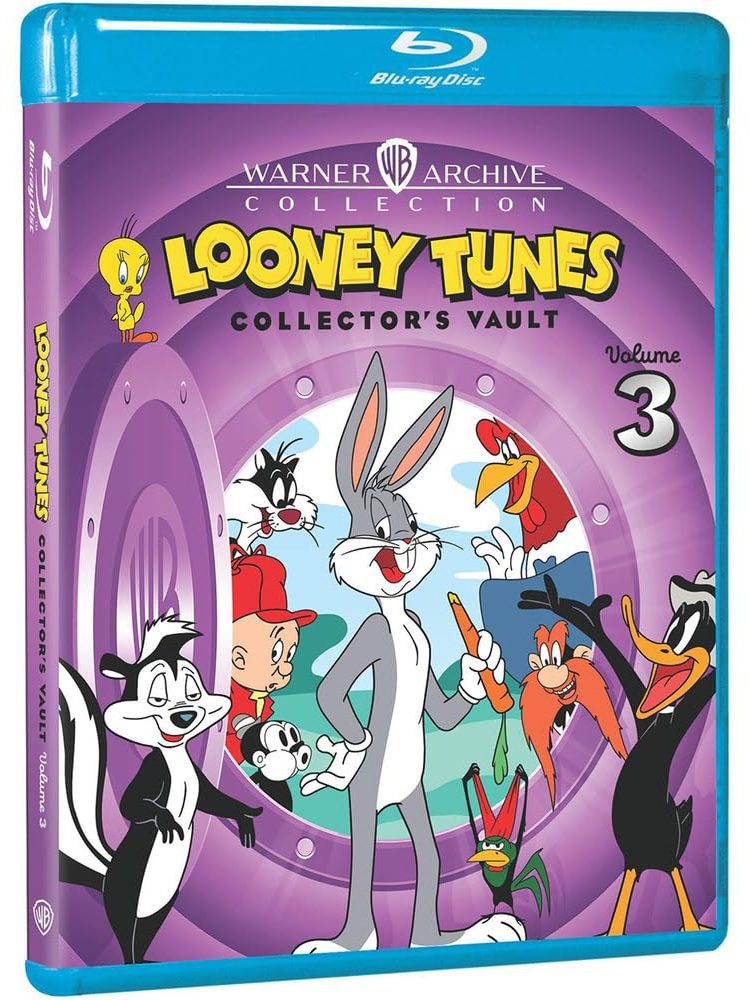
The Looney Tunes: Collectors Vault Volume 3 is a two-disc set of shorts from 1930 to 1960 with the first disc containing 25 new-to-disc cartoons while the second disc contains 25 newly-restored cartoons. Of the 50 cartoons, 10 are from the 1930s, 21 from the ’40s, 16 from the ’50s, and 3 from 1960. The cartoon title is followed by the year of release and its director, who is Friz Freleng for half the set.
Buy Looney Tunes: Collector’s Vault Volume 3 from Movie ZyngSpeaking of Friz, who also gets identified as “Isadore” and “I.” in the opening credits, the first two cartoons are by him from 1935. Billboard Frolics has a lot of good gags as illustrations on billboards come to life one night, both figures and objects. For example, old maids come off cleanser cans and dance as do a pair of Russian Rye loaves. Elmer is the Country Mouse. He wants to be a boxer and heads to the big city. He learns it’s not easy and who the better fighter in his family is.
Dog Gone Modern (1939, Chuck Jones) is the debut of Two Curious Puppies who enter a model house of the future where they encounter new conveniences like a robot that sweeps up, a napkin folder, and an electric dish washer. Elmer is a married farmer in Don’t Axe Me (1958, Robert McKimson). Daffy is a duck on his farm and Barnyard Dawg appears as Rover. With the Reverend coming by for dinner, Elmer decides duck is on the menu. There’s a funny twist (not to Daffy) at the end.
Don’t Look Now (1936) is the lone Tex Avery cartoon but doesn’t exhibit his trademark wackiness. It finds Cupid busy of Valentine’s Day but a li’l Devil works against him. Feather Bluster (1958, McKimson) is a compilation episode with clips from from Henhouse Henery (1949) and The High and the Flighty (1956) as old timers Foghorn and Barnyard reminisce.
An Indian hunts Bugs in A Feather in His Hare (1948, Jones). The character is a bit goofy, as most of Bugs’ adversaries are. The Gay Anties (1947, Freleng) is a very funny one-off filled with gags based around ants in a park, stealing and playing with food from a picnic. Back to the West for Horse Hare (1960, Freleng) where Bugs is in U.S. Cavalry. He stays behind in fort as soldiers head out. Renegade (Yosemite) Sam leads Indians to take the fort in a dubious alliance.
Next up are a couple black and white cartoons. Little “Joe Glow, the Firefly” (1941, Jones) explores a a man’s campsite in this cute cartoon. Lady, Play Your Mandolin! (1931, Rudolf Ising) is an early Merrie Melodies short with a lot of funny animals, including a fox that looks like a familiar mouse.
Speaking of mice, The Lyin’ Mouse (1937, Freleng) gets caught in a trap tries and to save himself from a cat tells him Aesop’s “The Lion and the Mouse.” The title gives away the ending. Mice Follies (1960, McKimson) is the third of three The Honeymooners as mice parodies. Ralph and Ned antagonize a cat who comes after them in their home. Has an odd ending.
Peter Cottontail has to babysit baby brother Elmer while mom is away in My Green Fedora (1935, Freleng). A weasel grabs Elmer to make a meal out if him. The art has good designs in the underground tunnels. The title Nothing but the Tooth (1948, Arthur Davis) doesn’t make any sense in this Gold-Rush era cartoon. Heading west, Porky passes through Indian country where he encounters a nerdy fella looking to scalp him.
A trio by Freleng follows. Of Thee I Sting (1946) is a very funny war-propaganda spoof with mosquitoes preparing to battle a man on his porch. Set in Venice, A Pizza Tweety-Pie (1958) is same old story of Sylvester pursuing Tweety. In Shake Your Powder Puff (1934), a show is put on by animals in a barn for other animals. A drunk dog in audience is kicked out and returns to cause trouble.
Sinkin’ in the Bathtub (1930, Hugh Harman & Ising) is notable for being the first Warner Bros. theatrical cartoon short, the first Looney Tunes short, and the first to star Bosko, who goes out for a ride with his girl Honey. Sleepy Time Possum (1951, McKimson) is a very funny cartoon about a young possum trying to sleep while his father looks for ways to keep him awake.
The disc concludes with five by Freleng including a trio starring Tweety & Sylvester. Slightly Daffy (1944) finds Daffy and Porky as Union soldiers at a fort where Indians attack. Filled with funny gags, especially liked Daffy swallowing bullets and turning into a gun. A Katharine Hepburn-sounding chicken heads to Hollywood to follow her dream in A Star Is Hatched (1938), but learns it ain’t so easy. It’s filled with a lot of good caricatures.
Tweety narrates Tree Cornered Tweety (1956) like a Dragnet episode as Sylvester chases after him. Sylvester and Sam (who sounds like Frank Fontaine) fight over Tweety rather than share him in Trick or Tweet (1959). In Tweet and Sour (1956), Sylvester is threatened with the violin-string factory (for catgut presumably, but they don’t use cats for that) if anything happens to Tweety while Granny away. Sam who has a different voice and an eye patch wants to eat Tweety.
After hearing Yosemite Sam wants to rid the country of rabbits, Bugs runs against him for Mayor. In Ballot Box Bunny (1951, Freleng), But as they fight, will they be too distracted to notice a dark horse candidate enter in the race? Boobs in the Woods (1950, McKimson) stars another battling pair as Porky wants to camp and paint in the woods while Daffy (and boy, is he daffy here) causes him problems.
In Booby Hatched (1944, Frank Tashlin), a mother duck loses Robespierre who hasn’t fully hatched. Thanks to his legs being the only thing to have broken through the shell, he wanders around looking for his mother’s warmth but finds it in a wolf’s house. The cartoon has a funny ending. Bugs takes on magician Ala Bahma in a funny battle during the latter’s act in Case of the Missing Hare (1942, Jones).
Conrad the Sailor (1942, Jones) swabs the deck and Daffy keeps dirtying it. This is the last of three Conrad cartoons with Pinto Colvig taking over the role from Mel Blanc, causing Conrad to sound an awful lot like Goofy. Daffy – The Commando (1943, Freleng) parachutes into Germany and causes mayhem, including an encounter with old Adolph. Porky goes duck hunting so he and Daffy are basically doing Elmer/Bugs in Duck Soup to Nuts (1944, Freleng) and it’s just as funny.
In Fox-Terror (1957, McKimson), a fox outsmarts Foghorn and Barnyard…for a while. It’s got a lot of good gags. Foxy by Proxy (1952, Freleng) is a remake of Of Fox and Hounds (Avery, 1940). A fox hunt passes by Bugs. He’s outraged at the practice and decides to take them on, including the dimwitted Willoughby, who is based on Of Mice and Men‘s Lenny. The drawings of the conglomeration of dogs is funny.
The Fresh Airedale (1945, Jones) is Shep, a bad dog that fools everyone except the cat that lives with him. The moral is there’s no justice in the world. Goldimouse and the Three Cats (1960, Freleng) is a variation on the classic story retold with Sylvester and Junior as two of the cats. As Sylvester tries to catch the mouse, it becomes like a Roadrunner/Coyote cartoon.
Hermann Göring is hiding in the Black Forest and is a stand-in for Elmer Fudd in Herr Meets Hare (1945, Freleng) against Bugs. Holiday for Shoestrings (1946, Freleng) is a retelling of The Elves and the Shoemaker set to Tchaikovsky’s The Nutcracker. It’s funny when shoemaker awakens and seeing the work tries to sneak out for a round of golf. Hollywood Daffy (1946, Hawley Pratt) sees him comes to town and sneak onto studio lot where he has to deal with a security guard. Has a lot of good Hollywood gags.
Due to war rationing, a wolf is out of meat in I Got Plenty of Mutton (1944, Tashlin). When he learns a local sheepdog has joined the army, he heads to the meadow, but the flock is guarded by a ram. Jones would revisit this concept with Ralph Wolf and Sam Sheepdog. Bugs gets caught in a cotton bale and sent aboard a paddle boat in Mississippi Hare (1949, Jones). He fights with feisty Colonel Shuffle, a Yosemite Sam stand-in.
Captain Shanghai (Yosemite) Sam tricks Bugs with a free ocean voyage and makes him the only crew member in Mutiny on the Bunny (1950, Freleng). The ship sinking multiple times is the best. Porky is out camping and is bothered by Daffy in My Favorite Duck (1942, Jones) but ducks are protected so Daffy ups the antics to Porky’s great frustration since he can’t retaliate. There’s a funny bit having the film break, causing Daffy to explain how the cartoon ended…or does he?
The Pizzicato Pussycat (1955, Freleng) catches a piano-playing mouse and uses him to trick humans, leading to a concert at Carnegie Hall, which doesn’t go well. The cat proves proficient on drums and the pair form a jazz combo, but they tell no one outside. Petey is ordered to a home where birds keep disappearing in Puss n’ Booty (1943, Tashlin). The owner has no idea her cat Rudolph is the culprit. Will the pattern repeat? The concept would be redone with Tweety and Sylvester in Freleng’s I Taw a Putty Tat (1948).
Bugs helps a little brown bunny who is being chased by Pete Puma (Stan Freberg doin Frank Fontaine) in Rabbit’s Kin (1960, McKimson). Pete is so memorable I was surprised he only appeared in one short during the Golden Age. The repeated question “How many lumps do you want?” leads to funny bits. In New Orleans, Fabrette the cat has fur that looks like a skunk, making it tough to find a boyfriend in Really Scent (1959, Abe Levitow). Pepe Le Pew might be a good fit, but his scent is tough to take. The role reversal is funny.
A couple of showbiz-based cartoons by Freleng feature next. Elmer hunts Bugs and chases him into a theater putting on a show in Stage Door Cartoon (1944). There’s a great gag where Bugs dresses like a sheriff and arrests Elmer but the sheriff wants to stop and watch a Bugs Bunny cartoon. In A Star Is Bored (1956, Freleng), Daffy plays Bugs Bunny’s stunt double, leading to hilarious results that bring to mind their Rabbit Season/Duck Season rivalry. The set concludes with The Windblown Hare (1960, McKimson). The Three Little Pigs sell their weaker homes to Bugs. The Big Bad Wolf blows them down like book says. They team up to get revenge on the pigs.
Taken from 4K scans of the original negatives, the video for the cartoons have been given a 1080p/MPEG-4 AVC encoded transfer displayed at an aspect ratio of 1.37:1. The video delivers a wide spectrum of colored hues,from the lighter pastels in the ’30s to the bolder shades from later decades. Blacks are inky throughout and numerous shades of gray are apparent in the black & white cartoons. Film grain is evident. The image typically delivers a sharp focus. On occasion, as seen in My Green Fedora and Shake Your Powder Puff, the image blurs due to source issues and scratches can seen in background of Billboard Frolics.The audio is available in DTS-HD Master Audio 2.0 Mono. Dialogue is clear, as are the musical scores and sound effects. The tracks didn’t show signs of age or wear except on Shake Your Powder Puff. There are commentaries by Greg Ford (on Case of the Missing Hare, Fresh Airedale, and Herr Meets Hare), Eric Goldberg (Mississippi Hare) and Jerry Beck (My Favorite Duck).
Buy Looney Tunes: Collector’s Vault Volume 3 from AmazonThe Looney Tunes: Collectors Vault Volume 3 is a great set of cartoons, made all the more wonderful by the rare shorts included which will delight long-time fans and those new to them. Don’t know what else in the in vault, but I am definitely looking forward to a potential Volume 4.
