
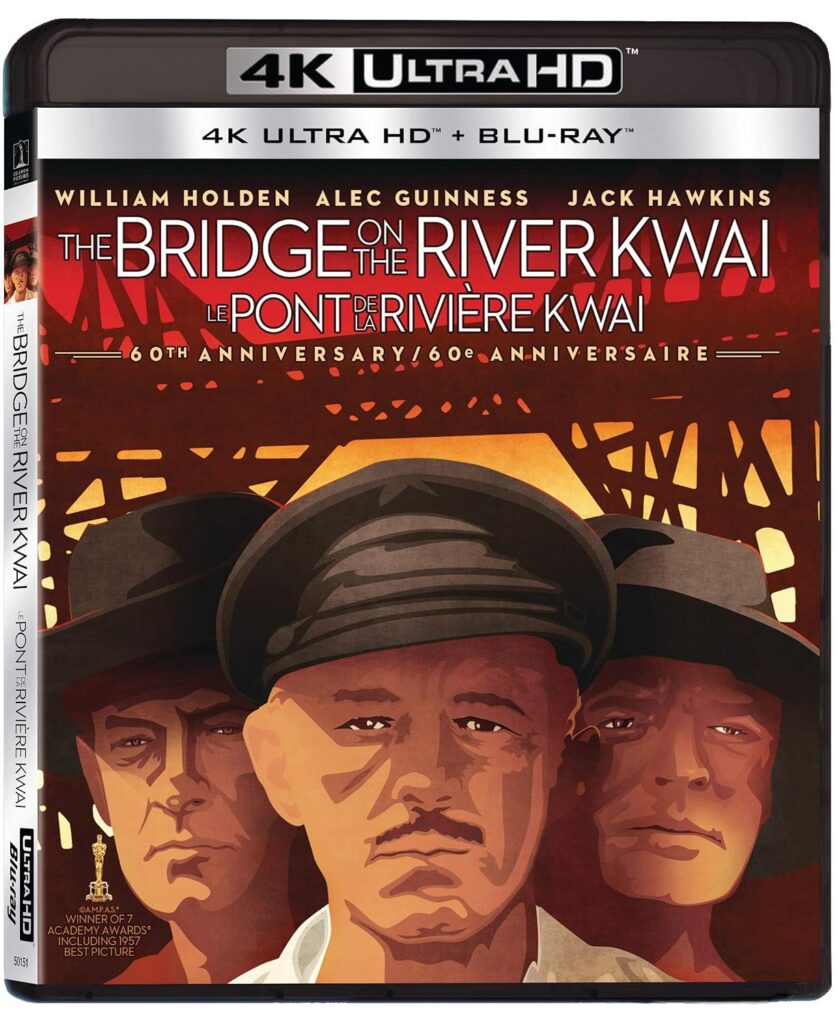
David Lean’s The Bridge on the River Kwai is the kind of film that can make a spectacular achievement feel deeply unsettling. On the surface, it is a war epic about British prisoners of war forced to build a bridge for their Japanese captors in Burma. Beneath that surface, however, it becomes a complicated examination of pride, obsession, duty, and the ways people can become so committed to their principles that they lose sight of what those principles were supposed to mean.
Buy The Bridge on the River KwaiThe film centers on Colonel Nicholson (Alec Guinness), the senior British officer among the prisoners. After resisting Japanese demands that British officers perform manual labor, Nicholson is imprisoned and brutally punished. Once released, however, his determination to uphold British discipline takes an unexpected turn: he becomes personally invested in constructing the bridge, treating its successful completion as a demonstration of British competence and military pride.
Meanwhile, an escaped American prisoner, Commander Shears (William Holden), is recruited by Major Warden (Jack Hawkins) for a mission to destroy the bridge. The resulting conflict gives the film its central tension. Nicholson sees the bridge as a monument to discipline and achievement; Warden sees it as an enemy military asset. Both men become increasingly consumed by their respective ideas of duty.
Lean directs the film on an enormous scale without allowing the spectacle to overwhelm the characters. The jungle landscapes are magnificent, the construction of the bridge is presented with painstaking physical detail, and the climactic sequence is genuinely suspenseful. Yet the movie’s greatest accomplishment is the way its grand spectacle gradually becomes a portrait of psychological collapse.
Guinness won an Oscar for his performance, and it is easy to understand why. Nicholson’s transformation is subtle enough that the audience can recognize the honorable man he was even as his behavior becomes increasingly absurd. Guinness avoids turning him into a caricature, instead allowing his rigid sense of responsibility to become gradually distorted by vanity and obsession. Sessue Hayakawa is equally effective as Colonel Saito, giving the Japanese officer dignity and vulnerability beneath his authoritarian exterior. Holden provides a more conventionally charismatic presence, although the film ultimately belongs to Guinness.
The famous conclusion is particularly effective because it refuses to reduce Nicholson’s downfall to simple villainy. His final actions are horrifying, but they are also the logical culmination of the worldview he has embraced. The film’s famous question about madness is therefore more than a punch line. It is an indictment of the ability to mistake obsession for honor.
The Bridge on the River Kwai won seven Academy Awards, including Best Picture, Director, and Actor, and its reputation as a classic is deserved. More importantly, it remains an unusually thoughtful war movie, one in which courage and foolishness can occupy the same uniform. Its bridge is an impressive piece of engineering, but the real structure Lean is examining is the fragile architecture of pride.
