
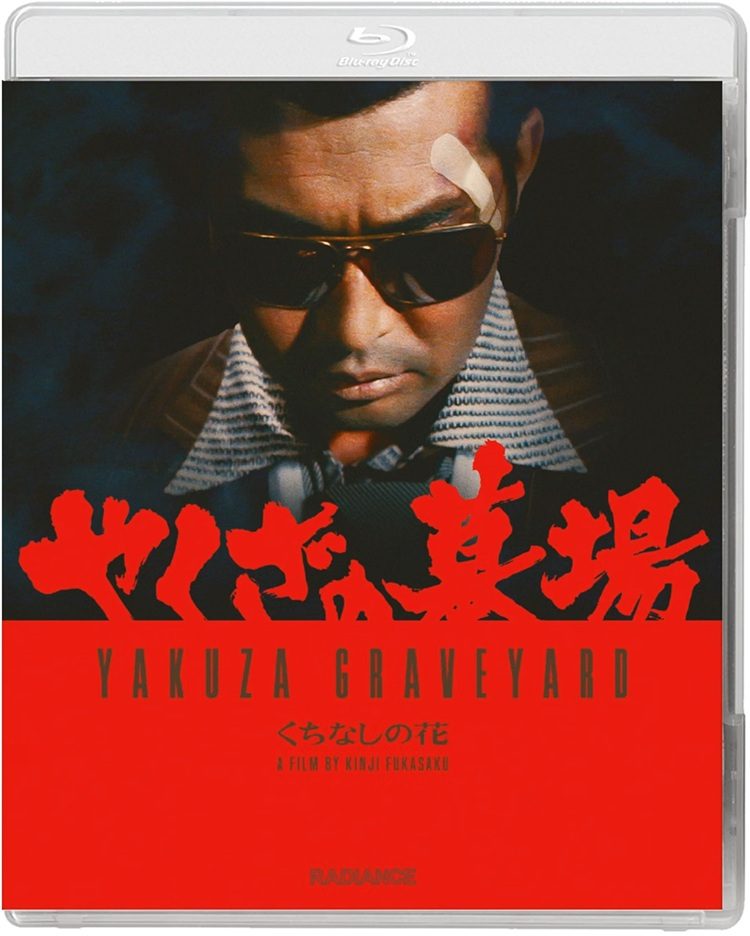
Kinji Fukasaku directed some 60 films in his storied career. He made films in nearly every genre, but he’s best known for a series of gritty yakuza movies. In the States, he’s probably best known for Battle Royale, his thrill-ride genre picture about a group of 9th graders sent to an island and forced to kill each other (which no doubt inspired Suzanne Collins ‘ Hunger Games series). Worldwide, he’s known for his Battles Without Honor and Humanity series of films. And many others. We’ve reviewed numerous films of his on this site.
Buy Yakuza GraveyardAnd now I’m reviewing another one. Yakuza Graveyard falls straight into the gritty crime genre Fukasaku loved to play in. It is certainly gritty, but it’s not as good as the other films of his I’ve seen, nor as fine-tuned. Tetsuya Watari plays Kuroiwa Ryu, a tough, rough cop who isn’t afraid of getting his hands dirty (or bloody) and plays by his own rules. He’s so out of control he’s sent to the Yakuza to help stop a brewing Yakuza war.
The Osaka cops are as corrupt as can be, and they don’t actually mind the various Yakuza gangs controlling things like gambling, prostitution, or drugs, but they don’t like a war. That leaves too many bodies on the ground, and bodies bring unwanted attention from the national government.
Kuroiwa has a lot of fun busting heads and wreaking havoc. He does it so well that the Nishida Family tries to recruit him to their side. At first, he says no, but then they push Matsunaga Keiko (Meiko Kaji) to convince him. She’s the wife of the imprisoned boss and thus works as a sort of underboss (albeit in a limited capacity, as she’s just a woman). She asks Kuroiwa to take her to visit her husband. The gang wants to declare a new boss since he’s going to be in prison for a long time, and she wants to obtain his permission. The boss refuses and verbally abuses her. Visually upset, Kuroiwa comforts her. One thing leads to another, and the two become lovers.
He actually already has a lover. She was the lover of a Yakuza he shot and killed many years prior. She freaked out, took some pills, and he more or less rescued her. They regularly meet in a cheap hotel, have sex, and he gives her pocket money. She actually cares for him, but he spends time with her out of some sense of guilt and duty rather than any real emotional pull. These scenes don’t really go anywhere, and she basically disappears from the movie at some point, but they point to the type of man he is.
He continues to bust any Yakuza heads he can find. One night, he gets into a melee with half a dozen Nishida guys. It ends with basically a draw. Bruised and battered, Kuoiwa retires to his room, but soon after, Iwata, who was just fighting with him, comes in and makes a truce. He gives him a beer and invites a couple of sex workers in. They become fast friends and ultimately take an oath as brothers.
None of this sits well with the rest of the police squad, especially since they are on the side of the rival gang. There are lots of arrests, plenty of action, and a big old war to end things on.
Fukasaku infuses it with a gritty, chaotic energy that is rather mesmerizing. But it is also very downbeat and ultimately rather bleak. Outside of the action and violence, we get a look inside of Kuriowa’s psyche, and it isn’t a pretty place. This entire world is pretty unwelcoming. The Yakuza are horrible; the cops are corrupt. Poor Keiko has been abused her whole life and has always felt out of place due to her father being Korean. This is a movie that isn’t afraid to get dark. I’d argue that’s to its detriment. In doing so, Fukasaku loses that spark so many of his films have. It is still very much worth watching, just not as great as his best films.
Radiance Films has done their usual wonderful job presenting Yakuza Graveyard to us.
Extras include the following:
- The Rage and the Passion – A visual essay by critic Tom Mes on Meiko Kaji and Kinji Fukasaku’s collaborations (2022)
- Appreciation by filmmaker Kazuya Shiraishi (2022)
- Easter Egg
- Trailer
- Newly translated English subtitles
- High-Definition digital transfer
- Original uncompressed mono PCM audio
- Gallery
