
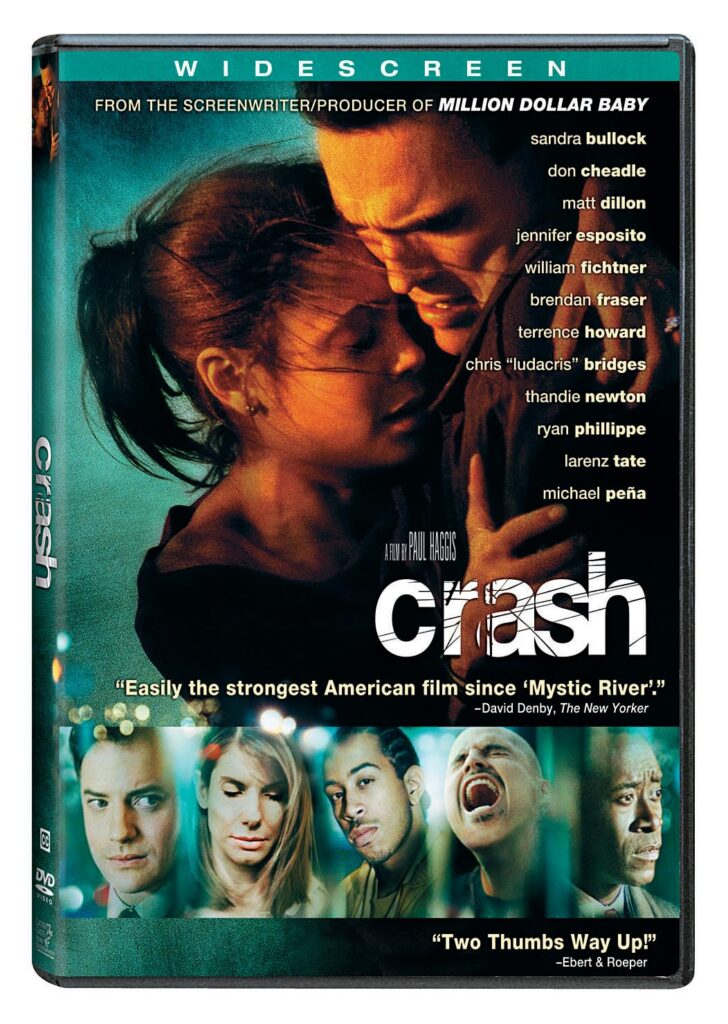
Paul Haggis’s Crash, which won the Academy Award for Best Picture, is the sort of movie that practically begs to be argued with. It tackles racism, prejudice, fear, and social division through a series of interconnected stories involving residents of Los Angeles, bringing together police officers, criminals, politicians, immigrants, and ordinary citizens whose lives repeatedly intersect. It is ambitious, emotionally manipulative, occasionally powerful, and considerably less profound than it seems to believe it is.
Buy CrashThe movie begins with a car accident involving Detective Graham Waters (Don Cheadle) and his partner, Ria (Jennifer Esposito), then jumps backward through the previous 36 hours to show how various characters have collided, both literally and figuratively. A district attorney’s wife (Sandra Bullock) becomes increasingly fearful after being carjacked. A racist police officer (Matt Dillon) abuses his authority during a traffic stop. A television director (Terrence Howard) and his wife (Thandiwe Newton) encounter that officer. A Persian shopkeeper (Shaun Toub), a Mexican-American locksmith (Michael Peña), two carjackers (Larenz Tate and Ludacris), and several other characters become caught in the same sprawling web.
Haggis clearly wants to make the point that prejudice isn’t confined to one race, one social class, or one political ideology. Almost everyone in Crash is capable of making assumptions about somebody else, and almost everyone is capable of surprising kindness as well. That is a worthwhile idea, and the film occasionally dramatizes it effectively.
The problem is that Haggis rarely trusts the audience to discover the point on its own. Characters don’t simply behave badly or compassionately; they frequently behave badly or compassionately in ways that seem designed to underline the movie’s thesis. The coincidences pile up, the revelations arrive with clockwork regularity, and the emotional buttons are pushed so aggressively that the movie sometimes feels less like an examination of racial prejudice than a particularly elaborate after-school special for adults.
Still, there are some terrific performances. Don Cheadle brings weary intelligence to Graham, while Matt Dillon gives the movie its most complicated and unsettling performance. His Officer Ryan is unquestionably racist and abusive, yet Dillon finds enough vulnerability beneath the character’s ugliness to make him more than a cartoon villain. Thandiwe Newton is also excellent, particularly in the harrowing traffic-stop sequence.
The movie’s greatest strength is its willingness to make uncomfortable observations without assigning virtue exclusively to one group. Its greatest weakness is the simplistic way it ultimately organizes those observations. Crash wants to suggest that everyone is capable of prejudice, but sometimes seems to confuse moral complexity with giving every character a turn being both victim and perpetrator.
That may help explain why its Best Picture victory has aged so awkwardly. Crash beat Brokeback Mountain; Capote; Good Night, and Good Luck.; and Munich, and its victory is now often remembered as one of the Academy’s more questionable choices. The movie isn’t worthless, but its reputation as an important cinematic statement has probably outgrown what is actually on the screen.
Crash is an earnest, well-acted, aggressively constructed drama that wants to leave its audience wrestling with complicated questions about race and human behavior. It succeeds at starting that conversation. Unfortunately, it spends so much time explaining what we are supposed to think that it leaves considerably less for us to wrestle with than it imagines.
