
Boy, does it seem like movies have gotten longer these days. I mean, really long. It is almost as if the studios have decided that if we don’t sit in the theater for three hours, we haven’t gotten our money’s worth. I’m not opposed to long run times, but the movie needs to earn it. Lawrence of Arabia deserves all of its three hours and forty minutes. I was enthralled by every one of Killers of the Flower Moon‘s 206 minutes. But there is no reason on God’s green earth that Masters of the Universe needed to be over two hours. Movies based on toys from the 1980s should never take over 90 minutes of my time.
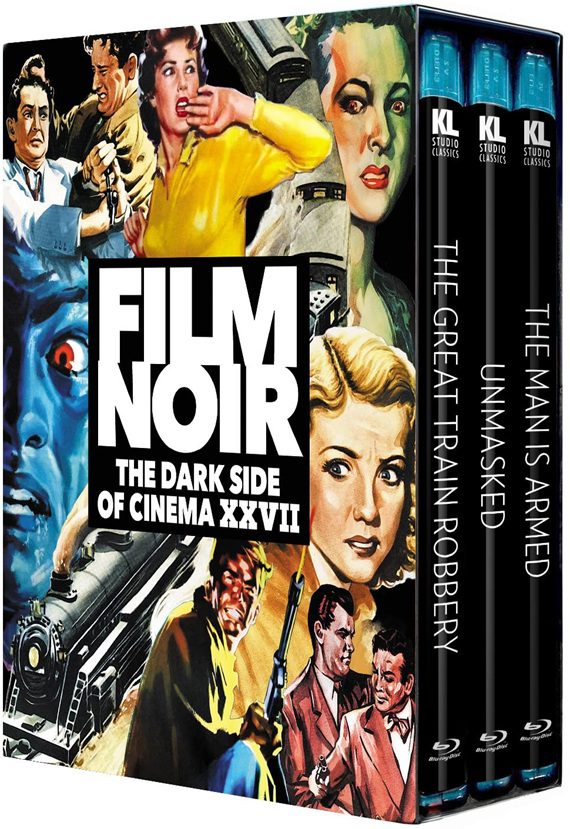
Buy Film Noir: The Dark Side of Cinema XXVIII can’t tell you how thrilled I was when this Film Noir package landed on my desk. All three films in this set from Poverty Row studio Republic Pictures come in at about 60 minutes. I can watch this entire boxed set in less time than it takes to watch most Marvel movies. These films are better than half the MCU as well.
Can we get some movie studios to start doing more of that, please?
With a name like Great Train Robbery, our first film sounds more like a western than a noir. There are certainly elements of the western in it, but it has a modern setting (well, modern for when it was made, which was 1941). There are no horses or cowboys, only cars and trucks, and telephone calls.
It has an interesting structure, as the first half sets up a question and the second half answers by rewinding, showing us what happened from a different perspective. It begins with a train, one loaded with gold. Tom Logan (Bob Steele) is a railroad detective hired to keep the gold safe, but he’s nowhere to be found. His supervisor looks everywhere for him. The townsfolk all assure him that Tom is a good guy; he’ll be there soon.
Just before the train departs, Tom does show up, albeit a bit disheveled and looking like he got into a barroom fight. He says he’s ok, gets on the train, and it departs. As it is leaving, Kay Stevens (Claire Carleton) shows up, also a bit disheveled. When she learns Tom is already on the train, she runs and jumps on it herself.
At some point, the boss man realizes the train is about to be robbed. He calls ahead to the next station to have them flag it down and make it stop. But the train flies on through; it doesn’t even slow down. They call ahead to the station after that, waking the old man up. As he’s on the phone, he hears the train pass by. The train never makes it to the station after that. Several men grab a train at the first station and take it to the farthest station, hoping to find the train somewhere along the way, but they don’t. The train has disappeared.
This is where the film resets and starts from the beginning. This time we follow Tom, find out what happened to him before he jumped on the train, and then what happened to the train. I won’t spoil any of that, but it’s a pretty neat trick. Director Joseph Kane keeps things moving at a steady pace. The whole thing is really well done, and that plot switcheroo is surprisingly effective.
Unmasked, our middle film in this set, isn’t nearly as interesting. The only reason to watch it at all is for Raymond Burr, and even then I can only recommend this if you are a hardcore fan and a completist. Burr plays Roger Lewis, a sleazy tabloid newspaper man who’s been having an affair with the wife of a wealthy businessman. Lewis has been borrowing money from the woman, giving her IOUs that she keeps in her husband’s safe. When he sees an opportunity, he kills the woman, burns the IOUs, and frames the husband for it.
That’s a pretty good setup, and for the first ten minutes or so, this film has the makings of something pretty special. But then it squanders everything and becomes as fun as a damp washcloth. They introduce far too many characters, give none of them enough time to fully develop, and lose any sense of tension they developed in that opening act. Burr has been quite good in other films at developing a calculating menace, but he’s not given enough screen time (or a decent enough script) to do much of anything here.
The final film in this set, The Man Is Armed, fares much better. Dane Clark stars as Johnny Morrison, a man who has just been released from prison for a crime he didn’t commit. He visits the dude he thinks set him up. They get into a tussle on top of a building, and the dude gets shoved off, falling to his death. He then gets a visit from his former boss, a man named Hackett (William Talman), who runs a trucking operation. He’s the guy who really set Johnny up, and now that he knows Johnny has killed a man, he’ll force him to pull a bank job for him.
Johnny goes along with the scheme, and Hackett makes him the gang’s leader. Johnny then throws a wrench into the proceedings every chance he gets. There is also a love interest, Carol Wayne (May Wynne). She and Johnny were together before he went to prison, but now she’s with another guy. That gives the film a little romantic drama to offset all the tough-guy action. But of course it is the tough-guy action that makes this film so compelling. Johny does steal the money, but then Hackett thinks he’s going to take the loot and run, which leads to a nice showdown at a cabin in the woods.
The Man Is Armed never quite rises above its Poverty Row existence. It is pulpy and clearly low-budget, but also a lot of fun. Clark and Talman chew the scenery. Director Franklin Adreon delivers some clean action and builds the tension. It is pretty much everything you want from a low-budget, B-tier noir.
I feel like 27 sets into this series from Kino Lorber, everybody knows what they are getting into. I can’t imagine there is anyone looking at this set thinking this is where they should start making their purchases. Although they could, as these collections are just sets of noir films that you can watch in any order you want. Kino Lorber usually gives each set some semblance of cohesion – this set, for example, all come from Republic Pictures in the 1950s. You really could purchase this set having never seen any of the other sets before it. But I suspect most folks try to collect them all. The question for those collectors, then, is whether or not this set is worth the purchase. To put it another way, after 27 sets, has Kino Lorber run out of interesting film to release? My answer is a decided “no.” Despite my reservations over Unmasked, the other two films more than make this worth a purchase.
Extras on this set include the following:
- Audio Commentary for The Great Train Robbery by Film Historian Gary Gerani
- Audio Commentary for Unmasked by Author/Film Historian Alan K. Rode
- Audio Commentary for The Man is Armed by Mystery Writer and Filmmaker Max Allan Collins with Film Historian and Host of Cereal at Midnight Podcast, Heath Holland
