
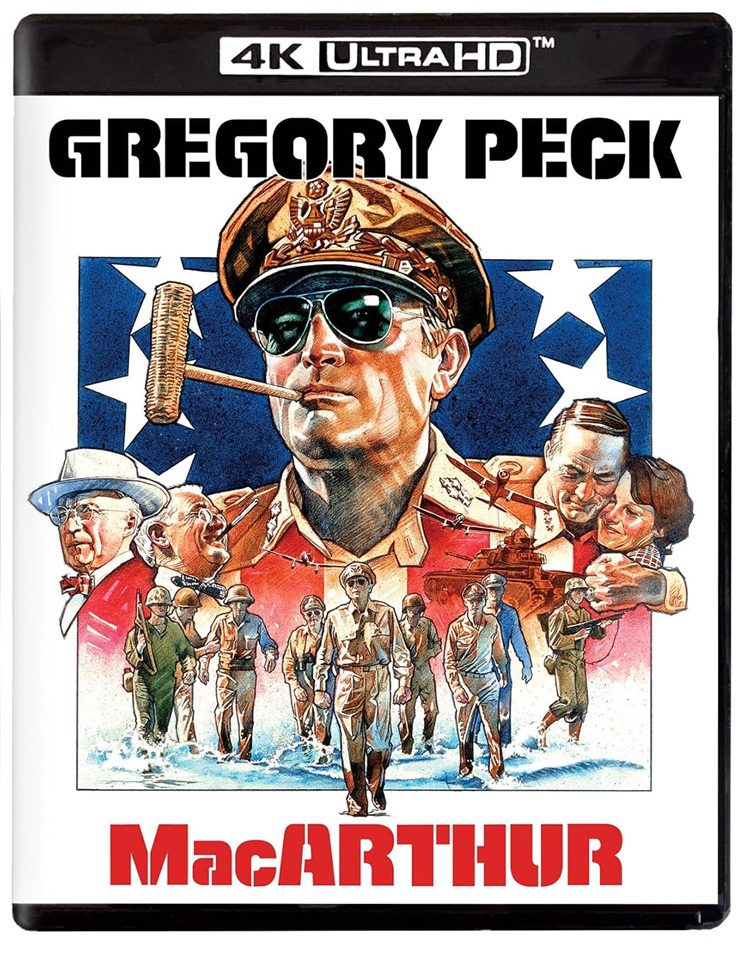
I find it impossible to talk about MacArthur without comparing it to Patton, the 1970 film starring George C. Scott that won seven Academy Awards and was listed as the 89th greatest movie in AFI’s 100 Years…100 Movies special. I suppose it was inevitable, after the success of that film, that they’d make a movie about the other great general from World War II. But MacArthur pales in every conceivable way to Patton.
Buy MacArthurYou can tell this from the very beginning. Patton begins with that iconic, profanity-filled speech. George C. Scott stands tall in his medal-laden uniform, with pearl-handled pistols on his side, a giant American flag hanging in the background. He gives a rousing speech to a group of unseen young men preparing for war. MacArthur also begins with a speech, but it is much more subdued. The war is long over. This is MacArthur giving a speech to cadets at West Point toward the end of his life. It doesn’t rouse anything.
Patton had a strong point of view. It showed us with great flair who Patton was as a man and a general. George C. Scott delivers an impeccable performance throughout. His Patton is bigger than life, an icon for a generation. MacArthur, on the other hand, spends its time trying to myth-make; it desperately wants to turn the general into an icon, but it fails miserably at it. The MacArthur of the film seems obsessed with his own myth. At every turn, he seems to carefully consider how it will make him look, what historians will write about him.
Even star Gregory Peck complained about the poor script and the low budget. Though most of the film takes place overseas in places like the Philippines, Japan, and Australia, the film was mostly shot in a studio in California. Peck gives a fine performance. It isn’t as flashy as Scott’s, but he gives the general great gravitas, while also being a man of great self-importance.
After his speech, which will serve as a bookend to the film, we move to the Philippines and the Battle of Bataan. U.S. forces, along with the Philippine soldiers, are being pummeled. U.S. High Command has promised to send reinforcements, but they haven’t come. There is a great moment where everyone is moving into a cave for safety. MacArthur sits high in his Jeep. Japanese planes drop bombs all around them. Everybody ducks and runs, but not MacArthur. He doesn’t even flinch. It’s as if he cannot fathom the possibility of getting killed. Later in the film, there will be another scene where he moves his Jeep to the front lines of the fight to the surprise of the men.
When President Roosevelt (Dan O’Herlihy) orders him to go somewhere else, to leave the Philippines, he considers disobeying orders even if it means a court-martial. It is clear he cares for these people, but clearer still is the fact that he feels that leaving the country would be like surrendering. He can’t stand to think of what that will do to his reputation. Famously, he vows that he will return. When he finally does, he brings a film crew with him. Our movie makes a show of the camera crews arguing over the placement of the cameras and the best way to show this triumphant entry.
Later, MacArthur has a meeting with Roosevelt and shows up late, making an entrance by driving up in a fancy sports car. Later still, MacArthur will have a meeting with President Truman (Ed Flanders). It is the first time the two have ever met face to face. MacArthur once again shows up late, making Truman wait in his plane as he feels like MacArthur should be the one to greet him on the tarmac.
In between those meetings, a lot happens. MacArthur helps win the war. He’s not happy we dropped the bomb instead of invading. He helps rebuild Japan. He runs for President. He leads the war effort in Korea. None of it is particularly interesting.
The back half of the film is a battle of wits between Truman and MacArthur. Truman wants to manage MacArthur and the way he’s leading the fight in Korea. As Commander-in-Chief, Truman figures MacArthur ought to follow orders, but he’s got different ideas. This ought to be compelling stuff, but I found myself rather bored. The film never really captures my attention. It certainly didn’t make me understand MacArthur any more than I did at the beginning of the film.
Kino Lorber presents MacArthur with a new 4K transfer from the original camera negatives. It looks terrific. Extras include an audio commentary with film historians Steve Mitchell and Steven Jay Rubin and some movie trailers.
