
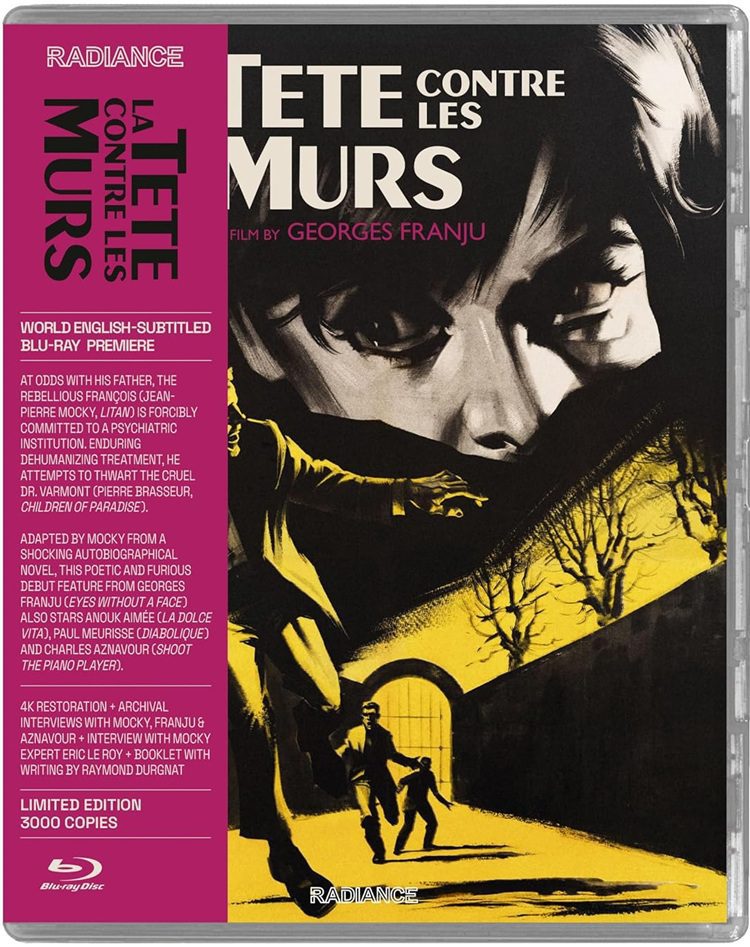
George Franju cut his teeth making political documentaries. One was a blood soaked look inside a slaughterhouse. Two others were commissioned by the French government, designed to be pro-France propaganda pieces, but Franju turned them into harsh critiques.
Buy La Tête Contre les MursHe got his chance to direct his first feature film in 1959 almost by accident. According to the essay by Raymond Durgnant, which is included in this new Blu-ray release by Radiance, Jean-Pierre Mocky had intended to direct La Tête Contre les Murs, which would be based on his own screenplay, but he couldn’t get the funding for it, as he was an untested director. All the big named directors were busy. Finally, ready to give up, a journalist asked him who could direct, and he blurted out the name “Franju.” The people with the money somehow thought that that was a good idea, and the film was made.
You can certainly tell Franju started out as a documentary filmmaker with this; it has that look and feel to it. Shot in stark black and white with very formal camera movements, one could almost think that this story is true. It certainly is beautiful looking. Shot on location at the rural mental asylum surrounded by wide open country, it is treated like a painting.
The story is less beautiful, or interesting. Its focus is on François Gérane (Jean-Pierre Mocky), a bored, angry, and lonely rich kid. His mother drowned when he was young, and he blames his father, a lawyer (Jean Galand), for her death. He’s spent his youth acting out in various ways – running up gambling debts, staying out all night, partying, etc. The film begins with him in desperate need of some money to pay down a debt. He’s borrowed once too often from his friends. He goes to his father’s office and steals some money from the desk. Then he burns some important legal documents. Those mean nothing to him, but he knows his father needs them, so he burns them out of spite.
The father catches him in the act and threatens to phone the police. Instead, he has François committed to an asylum. For with a committal, you don’t need proof; there is no trial, and more importantly, there is no record and thus no scandal.
If you read any synopsis of this film, you’ll probably get the impression this is one of those movies where a decent (or at least not crazy) guy gets locked away in an asylum and is brutally mistreated. I certainly came to it with that idea in mind. With Franju at the helm, I expected it to be a treatise on how terribly mental asylums were back then.
This is not that film. François certainly looks at the asylum as a prison and tries to escape it multiple times. But as far as we see, he is not mistreated by the staff. The inmates all seem fairly harmless, and the setting is rather idyllic. At worst, Dr. Varmont’s (Pierre Brasseur) treatments are a little old-fashioned, and he is unwilling to listen to his younger, more progressive colleagues ideas. Vermont’s general philosophy seems to be that there isn’t really a cure for most of his patients, and therefore they simply need to be kept at the asylum indefinitely. But he does genuinely seem to care about them and does not treat them poorly.
It doesn’t help his cause that François wasn’t exactly a wonderful person on the outside, and on the inside he is sullen, angry, and constantly trying to escape. If he’d just try to improve himself, he might actually get out.
He’s periodically visited by Stéphanie (Anouk Aimée), a girl he met just before he was committed. It is unclear why she visits him or why she immediately falls in love with him, but this only causes him to want to escape even more.
Because the asylum doesn’t actually seem that bad, and because François could actually use some help, the film doesn’t have a central conflict that feels worth rooting for. Mocky’s acting style here is a bit of a blank slate as well. He’s mostly emotionless, which makes the audience project emotion onto him. I had none to give. Sure, his father is kind of a jerk, and he doesn’t really belong in an asylum, but he could use some help, and that place is willing to give it to him. His unwillingness to take it did not make me care for him in the least.
The filmmaking is good, and it is a pleasure to watch Franju develop his style. Radiance has done their usual excellent job of bringing the film to us. They’ve given it a new transfer, and it looks absolutely amazing. Extras include three archival interviews with Jean-Pierre Mocky, George Franju, and Eric Le Roy.
La Tete Contre Les Murs isn’t a great film, but if you are a fan of George Franju then this is well worth seeking out.
