
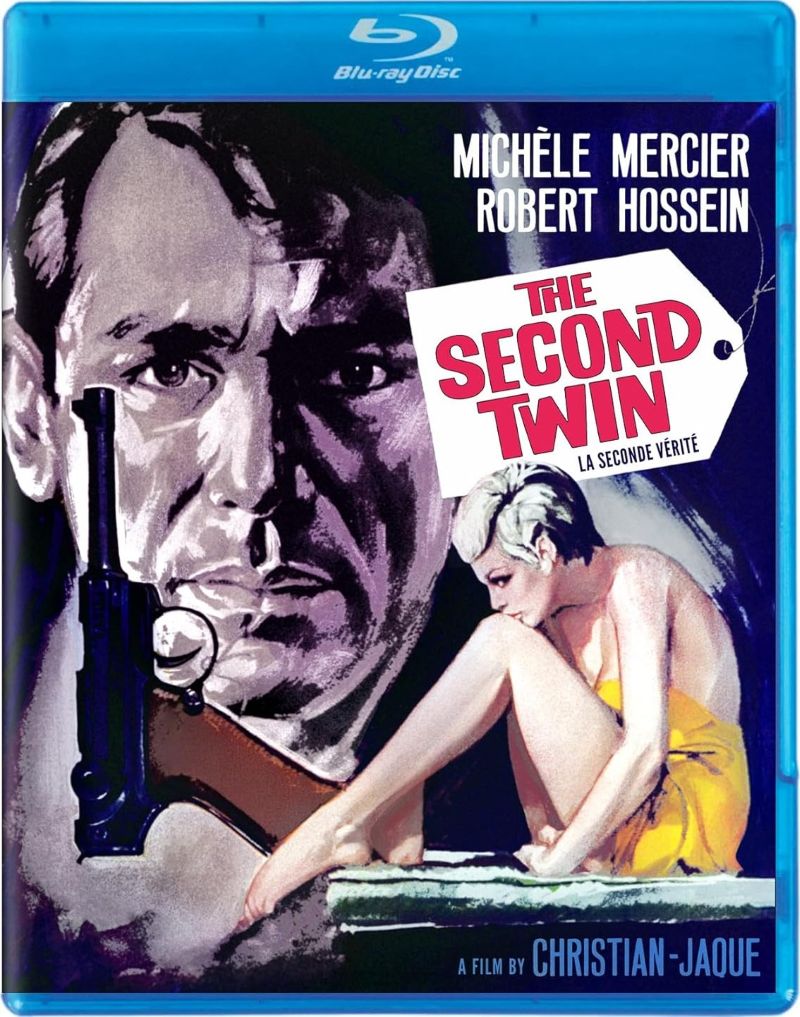
The U.S. title of Christian-Jaque’s 1966 crime drama promises a mysterious twist involving a twin, but it’s a total misdirection. The truth lies in the original French title buried in small type beneath the cover image title, La Seconde Vérité, quite literally The Second Truth. So, instead of a shadowy peripheral figure emerging later as a culprit, something like The Third Man, the story instead spins out from different character perspectives, similar to Rashomon.
Buy The Second TwinThe principal perspective is that of middle-aged attorney Pierre (Robert Hossein), a typically straight-laced husband who falls under the spell of sultry Parisian go-go dancer Nathalie (Michéle Mercier). When one of Nathalie’s other older paramours winds up dead, Pierre becomes the prime suspect, resulting in his conviction and incarceration. Upon his timely release, he struggles to reclaim his career due to the lingering scandal, leading him to investigate the crime himself to find the real killer.
As the investigation progresses, the plot switches to Nathalie’s perspective to retrace the same ground yet again, albeit with fresh insight. It’s fairly obvious how things are going to shake out, leaving it up to cinematographer Pierre Petit to spice things up with some surprisingly lively camera work. His camera constantly pans and zooms, and most significantly tilts quite a bit, framing the action at an angle to reinforce the off-kilter characters struggling in vain to return to some semblance of balance in their lives. It’s a flashy layer of sheen on what is otherwise a fairly staid, conventional directorial effort by the veteran pre-New Wave director, Christian-Jaque.
Similarly, Hossein seems to be struggling to keep up with the times, never quite at ease with his young co-star or Pierre’s dalliances in nightclub life and infidelity. That’s partly the nature of his uptight lawyer character, but he just seems generally beaten down and not fully committed to the role, especially compared to his phenomenal earlier works. Mercier is fine in her one-dimensional role, but a mostly uninspired choice compared to superior contemporaries.
So, we have an unsurprising plot directed by an aging traditionalist and starring so-so leads, leaving the intrusively stylish cinematography and glimpses of ‘60s Parisian nightlife to carry the weight. It’s by no means a disaster, but also so average that it’s hard to recommend to viewers outside Hossein’s fanbase.
On the upside, the Blu-ray features a new 4K restoration by StudioCanal, resulting in lush reproduction of the surprisingly robust color photography. Colors and brightness are superb, belying the film’s 60-year age. The 2.35:1 aspect ratio enhances the Parisian vistas, and crisp DTS sound reveals no flaws. While no bonus featurettes are included, the disc includes a new commentary track by a film critic.
