
I’ve now watched quite a few films made during Italy’s so-called Years of Lead, which lasted from the late 1960s through most of the 1980s. This was an era of political upheaval, corruption, heavy crime, and terrorism from both the far-right and far-left.
Buy Confessions of a Police CaptainItalian movies from this period often reflect those tumultuous times. This is especially true for two genres that essentially were created during the Years of Lead – the poliziotteschi (gritty crime dramas filled with explosive violence that often deal with political corruption) and the giallo (murder mysteries stylized as horror films that are often more political than you’d think). I love both genres and have recently come to realize how much they have in common with American films from the same period, especially the 1970s.
American action films in the 1970s were grittier and more violent than they’d ever been before and political. Films like The Conversation and The Parallax View took the country’s paranoia over the Vietnam War and the Nixon scandals and turned them into terrific conspiracy thrillers. Horror films like The Texas Chainsaw Massacre plugged into the violence and grim horror of the war, and Invasion of the Body Snatchers confirmed our fears of consumerism turning us into mindless, soulless ghouls.
What an absolutely great decade for cinema.
Damiano Damiani’s Confessions of a Police Captain should be talked about just as much as those other films. It is an incredible dive into the utter corruption of Italian politics at that time as well as the demoralizing nature of police work when the crime bosses walk hand in hand with the city’s leaders.
Bonavia (Martin Balsam) is a grizzled, beaten-down police captain who has grown so completely tired of the corruption that he releases a criminally insane prisoner named Michele Li Puma (Adolfo Lastretti) because he knows the prisoner will immediately run out and try to kill Ferdinando Lommuno (Luciano Catenacci), a local gang boss with whom he’s got a beef.
Things do not go to plan. Lommuno must have been tipped off, as he is not in his office when Li Puma arrives. Instead, he finds himself in a shootout with several dudes with machine guns. It is an absolute bloodbath.
Newly transferred and totally by-the-books Assistant District Attorney Traini (Franco Nero) is brought in to untangle what happened. Naturally, Bonavia is not forthcoming with how he let Li Puma out of the mental hospital. Though the two men are on the same side of the law and both want Lommuno behind bars, they have completely different dispositions and outlooks on how the law works.
Neither trusts the other either. Bonavia has Traini’s phones illegally tapped, while Traini does the same with Bonavia, except he does so legally. They regularly confer with one another, but each man leaves out bits of information in their discussions.
There is a wonderful scene where Bonavia takes Traini up onto a mountainside overlooking the city. He tells the story about how a lone worker fought back against Lommuno’s treatment of his workers (Lommuno is a land developer/construction magnate). He has the man killed and then tosses a young boy off that mountainside when he learns the kid was a witness to the first murder. Bonavia arrested Lommuno, but due to his connections with the mayor and other government officials, he got off. Traini understands Bonavia’s frustrations but still believes in the righteousness of the law and is unbendable in his need to stay straight-laced.
The two men argue furiously. Traini is beginning to realize that Bonavia may have had something to do with the massacre and threatens to arrest him while Bonavia threatens to slander the other man with some information he’s learned via the wiretaps. At a standstill, the two men storm off only to attempt to get into each other’s identical cars.
Central to the entire case is Serena Li Puma (Marilù Tolo), Michelle’s sister and Lomunno’s former lover. She was privy to a lot of criminal information when in bed with Lommuno, but with her brother’s death, she might be willing to testify. Fearing for her life, she’s disappeared. If our heroes find her first, they might be willing to finally put Lommuno behind bars, but if he learns where she is, he’ll no doubt kill her.
Director Damiano Damiani gives all of this a matter-of-fact composition. It isn’t nearly as stylized as a giallo or as graphically violent as the typical poliziotteschi. Which isn’t to say it isn’t thrilling (a scene in which some of Lommuno’s thugs go after Serena is particularly heart-pounding) or well done (Damiani is particularly good at staging his scenes).
I was completely engaged throughout its entire 101-minute runtime. I’ve seen enough Italian films from this time period to understand their particular rhythms, and while I wouldn’t say this is the cream of that particular crop, it is pretty dang good. A well-crafted, beautifully acted, political thriller.
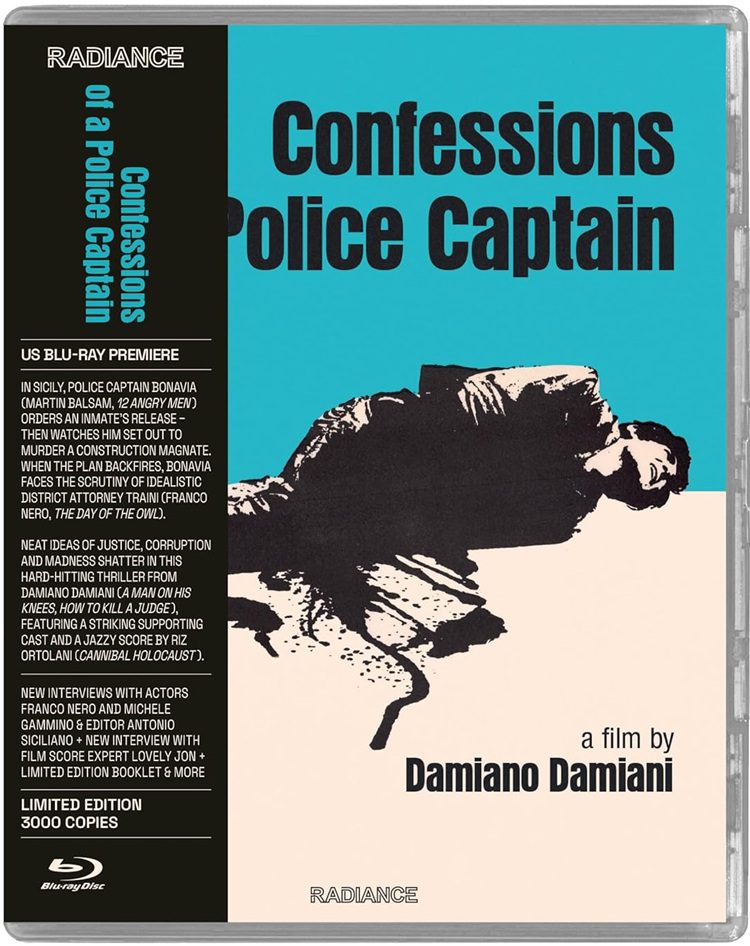
As per usual, Radiance Films has found a relatively obscure but still terrifically good film and given it the rock star treatment. They’ve given it a new 2K scan and the following extras:
- Interview with actor Franco Nero
- Interview with actor Michele Gammino
- Interview with editor Antonio Siciliano
- Interview with film score expert Lovely Jon about Riz Ortolani’s score
- Stills Gallery
- Reversible sleeve featuring designs based on original posters
- Limited edition booklet featuring archival interviews with Damiano Damiani
