
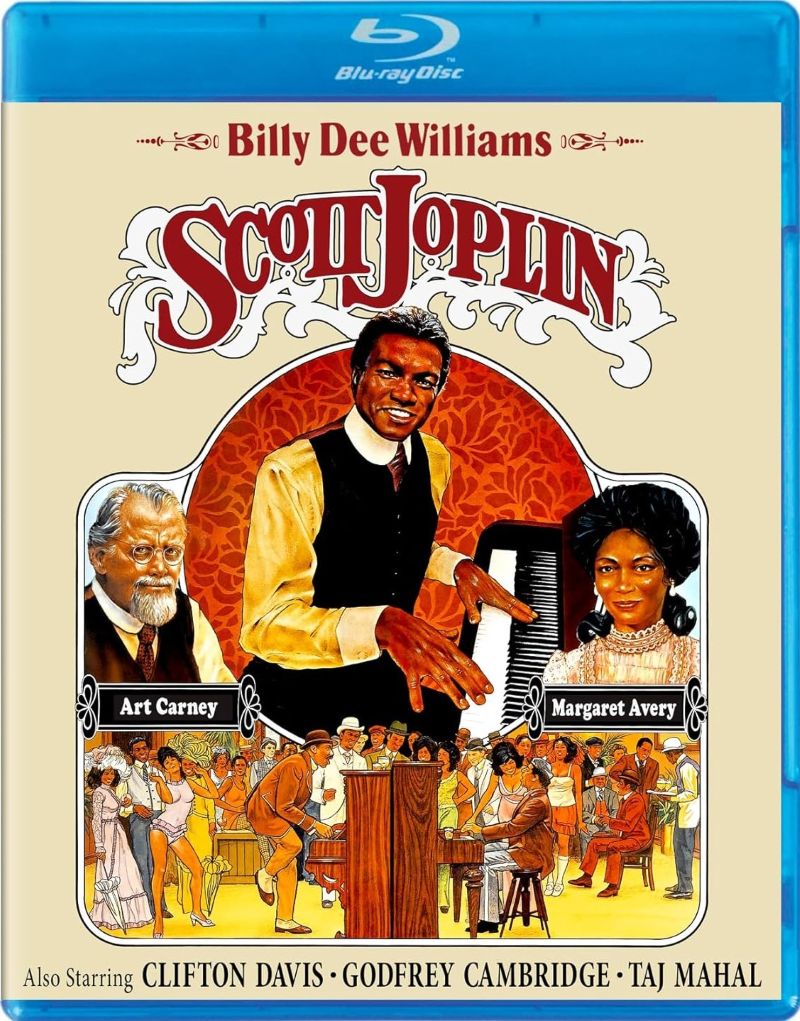
The famous American ragtime composer was at the peak of his popularity at the time of this 1977 biopic movie, a full 60 years after his death. Likewise, star Billy Dee Williams was riding high after two memorable pairings with Diana Ross: Lady Sings the Blues and Mahogany. With a hot star and heightened public interest in the film’s subject, writer Christopher Knopf and director Jeremy Paul Kagan were all teed up for success. Unfortunately, their resulting project is a bland, uninspired imagining of the composer’s murky history.
Buy Scott JoplinJoplin rose to success with the publication of his “Maple Leaf Rag,” the quintessential ragtime hit that has long served as the de facto sound cue choice for any old timey Americana. As detailed in the film, in spite of his success across multiple ragtime songs, he wasn’t content with being a commonplace hitmaker and instead had his sights set on the more respectable market of opera, completing two full works in his lifetime but garnering no success from them. It’s the age-old story of art vs. commerce, with Joplin obsessively fixated on the former.
Williams infuses his performance with Joplin’s perceived haughtiness, always in perfect posture in his crisp suits and speaking with upper-class diction. He constantly appears indifferent to the base bordello and music-hall shenanigans that paid his bills, even though we learn that Joplin definitely dallied in those shenanigans based on his life-ending affliction with syphilis. In short, Williams paints a striking figure as Joplin, but perhaps one with a far-too-hallowed approach.
Although Art Carney and Margaret Avery get top co-star billing, Williams’ best and most frequent scene partner is Clifton Davis as Joplin’s bawdier contemporary, Chauvin. Where Williams chooses to remain extremely restrained, Davis is free to frolic in the glory of his role as a slick ragtime performer and ladies’ man. He’s clearly there to paint the stark contrast between Joplin’s righteous quest to rise above the common fray and Chauvin’s desire to party, even as the two very similar men both succumb to the same fate. Carney and Avery hit their marks but little more in poorly developed roles as Joplin’s publisher and wife.
After dying penniless and buried in a pauper’s grave, Joplin was largely forgotten until pianist Joshua Rifkin popularized his music via multiple albums in the early 1970s. The renewed interest led to the use of Joplin’s music in The Sting, with his song “The Entertainer” becoming a breakout hit forever associated with that Best Picture winner. And that’s how we got to a major studio greenlight for a Joplin biopic a few years later, a seemingly impossible feat today. While the resulting project has all the production finesse of a made-for-TV film, it’s still an interesting slice of little-known American music history.
Although no restoration information is provided, the Blu-ray presentation is free of debris and maintains clearly defined definition and consistent color levels throughout all scenes. The flat cinematography offers little visual sizzle, while the hues gravitate toward sepia-tinged in keeping with its circa-1900 setting. The sole bonus feature is the theatrical trailer, but the disc includes a commentary track by the director, moderated by a film historian.
